Borehole Magnetic Resonance (BMR)
The only downhole tool that directly measures water content, pore size, and producibility.
What You Get:
What Is Borehole Magnetic Resonance?
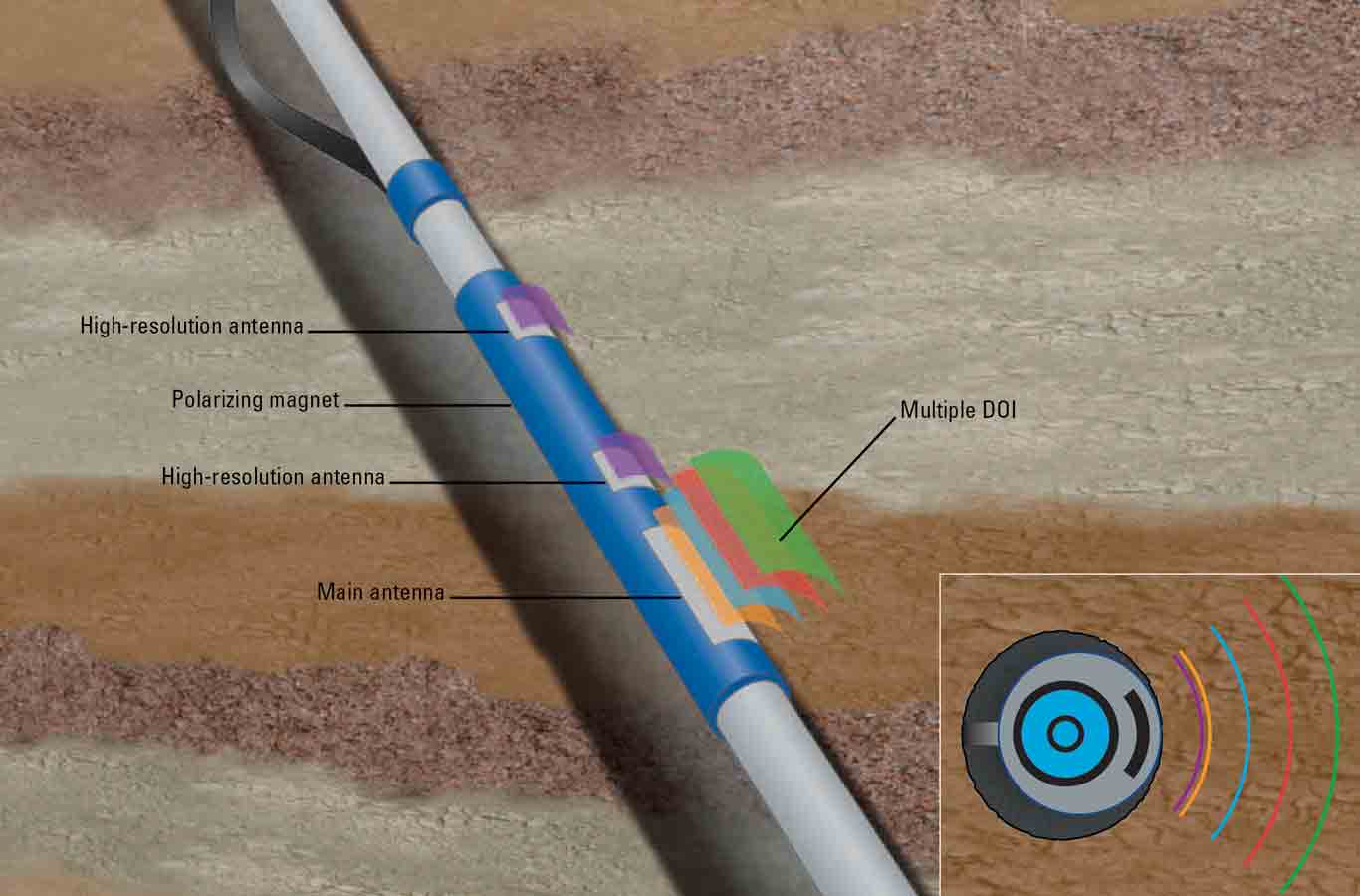
Borehole Magnetic Resonance (BMR) is an advanced logging technology that directly measures the water and hydrocarbons present in underground formations. While other logging tools measure rock properties and infer what fluids might be there, BMR measures the fluids themselves. It tells you not just how much water is in the ground, but how much of that water you can actually pump out.
This makes BMR the most powerful tool available for aquifer characterization, well yield prediction, and understanding how water moves through rock.
Why Standard Logs Are Not Enough
Conventional well logs — resistivity, gamma ray, density, neutron — measure physical properties of rock and infer fluid content indirectly. They are valuable for basic formation evaluation, but they cannot answer the most important questions:
- How much of this water is actually producible?
- What is the true hydraulic conductivity of this aquifer?
- Is the porosity effective (connected, flowing pores) or ineffective (isolated, dead pores)?
- What are the dominant pore sizes, and how do they affect flow rates?
- Will this formation sustain long-term pumping?
Without these answers, well designers and hydrogeologists work with incomplete information — potentially leading to undersized pump systems, inaccurate yield predictions, or missed productive zones.
How BMR Works
BMR works by sending a magnetic pulse into the formation and measuring how hydrogen nuclei in the pore water respond. The speed of their response directly relates to pore size:
- Fast response = small pores = bound water (not producible)
- Slow response = large pores = mobile water (producible)
This simple physics gives us a suite of measurements no other tool can provide.
Key BMR Measurements
- Volumetric Water Content — total water volume in the formation, measured directly.
- Pore Size Distribution — complete map from nanopores to macropores, revealing storage and flow characteristics.
- Total and Effective Porosity — total pore space versus connected pore space that contributes to flow.
- Bound vs. Mobile Water — how much water is locked in place versus how much can flow to your well.
- Hydraulic Conductivity — key parameter for groundwater flow modeling, derived from pore size data.
- Transmissivity — the aquifer's ability to transmit water over its full thickness. Essential for well yield prediction.
Applications
- Water resource development — optimize screen placement, predict sustainable yield, select pump capacity.
- Environmental remediation — characterize contaminant transport pathways and assess remediation feasibility.
- Geothermal — evaluate permeability and fluid content for geothermal energy projects.
- Oil & gas — advanced reservoir characterization, free-fluid analysis, and pay zone identification.
Expert BMR Service, 24/7
BMR logging requires specialized equipment and experienced operators. GeoCam is one of the few companies in Texas offering this advanced service. Our BMR team combines state-of-the-art instrumentation with expert data interpretation to deliver results you can act on. Available 24/7 — call 1-877-495-9121 to discuss how BMR can improve your next project.
What You Get
- Volumetric water content measurement
- Pore size distribution analysis
- Total and effective porosity
- Bound vs. mobile water quantification
- Hydraulic conductivity estimates
- Transmissivity calculations
- Permeability estimates (multiple models)
- Digital data files and log plots
- Detailed interpretation report
Frequently Asked Questions
Ready to Get Started?
Whether it's an emergency or a planned project, our team is ready to help.